Pattern hair thinning
Hair may become finer over time, particularly at the crown and part. The frontal hairline does not necessarily recede noticeably.

A widening part, a changed hairline or suddenly more hairs in the brush can have different causes. Whether a transplant may help depends on the diagnosis and a suitable donor area. Not all hair loss can be treated surgically.

A gradually widening part may be consistent with female pattern hair loss. However, a hairstyle does not establish a diagnosis. Sudden diffuse shedding, isolated bald patches and a receding hairline may have other causes. Several triggers may also occur together.
Hair may become finer over time, particularly at the crown and part. The frontal hairline does not necessarily recede noticeably.
More hair may shed some time after childbirth, illness or a stressful period. This needs to be considered differently from permanent hair loss.
Thyroid conditions, an actual nutrient deficiency, medicines or autoimmune conditions may play a role. Inflammation can also permanently damage follicles.
Tight hairstyles can put tension on hair roots. Broken hair shafts also need to be distinguished from shed hairs.
The hair medicine and medical investigation of causes explains different triggers before treatment is decided.
Assessment considers onset and progression, scalp changes, medicines, previous illnesses and hair care. Further examinations may be needed depending on the findings. A standard laboratory package or photograph alone cannot replace targeted investigation.
New bald patches, a rapidly changing hairline, pain, redness or scaling should be medically assessed. With inflammatory or scarring hair loss, controlling the condition may come first. Surgery does not automatically treat the cause. Do not change or stop medicines yourself.

Investigating the cause and discussing your questions come before a treatment decision.
Surgery may be considered for selected women with an established cause, a suitable hair situation and sufficient viable donor hair. This requires realistic goals and planning that accounts for possible further hair loss. Gender or visible thinning alone does not establish suitability.
With temporary increased shedding, investigating the cause takes priority. Active disease or insufficient suitable donor hair may also argue against transplantation. A personal examination determines whether treatment should be postponed or an alternative considered.
A transplant redistributes existing follicles; it does not create additional donor follicles. The thinning patch is therefore not the only consideration. The back and sides must also be examined for density, hair thickness and possible thinning.
If thinning also affects the potential donor area, the usable reserve may be limited or unsuitable. A photograph of the part cannot answer that question. Extraction extent and desired coverage must align so extraction itself does not cause noticeable thinning.
The general hair transplantation information explains the limited donor reserve in a wider context.
Planning first distinguishes between coverage at the part, an individual area and the hairline contour. Existing growth direction, hair thickness, parting and how you wear your hair all matter. A standardised “female hairline” does not suit everyone.
A lower hairline also uses donor hair. Desired shape, possible density and the longer-term reserve therefore need to be discussed together. Required trimming or shaving, visible extraction areas and your hairstyle afterwards should be discussed before deciding. Unshaven treatment is not promised here.
After examination, informed consent and planning, your own follicular units are extracted from a suitable area and placed into the planned recipient area. Placement must consider existing hairs, their direction and the desired distribution.
FUE describes individual extraction and DHI an implantation technique. The two steps can be combined; this does not imply general superiority. Anaesthesia, preparation, who performs the procedure, appointment locations and aftercare must be clarified for the specific treatment.
The different functions are explained in our FUE and DHI method comparison. It does not replace a suitability assessment.
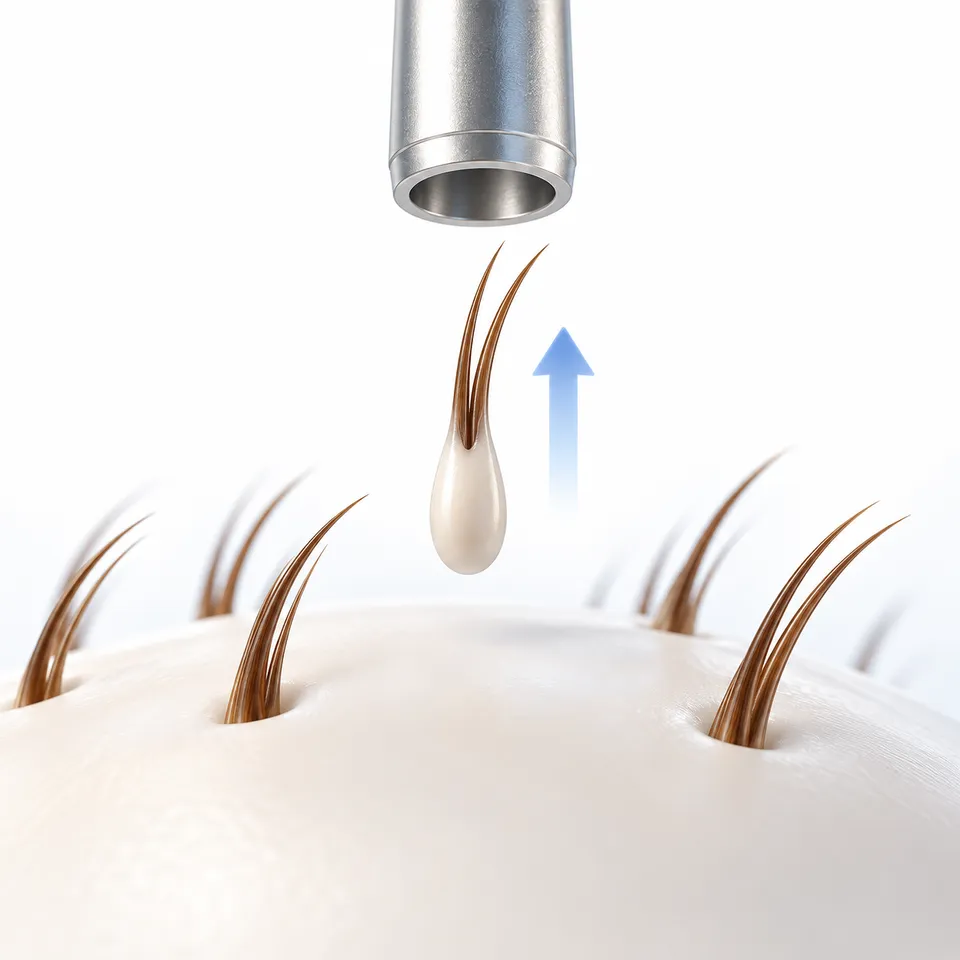
Transplantation requires suitable donor hair; the illustration explains the extraction step only.
Possible risks include bleeding, infection, scarring, insufficient growth and an unwanted distribution or contour. Existing hair may also shed more temporarily after surgery. If hair loss continues, coverage may change again later. A particular density or permanently unchanged overall appearance is not guaranteed.
Redness, swelling and crusts may occur. Cleaning, hair care and rest follow the individual medical aftercare plan.
Transplanted hair shafts may initially shed; new growth develops later over months. The appearance immediately after surgery is not the final result.
Growth, the donor area and the development of remaining hair need to be assessed together. Follow-up appointments and contacts for unusual symptoms should be agreed in advance.
The wider context is explained in our information on healing and aftercare. Fixed timeframes for work, sport or colouring cannot be applied to every woman on this basis.
Depending on the diagnosis, priorities may include treating an underlying condition, avoiding ongoing traction or considering medicines. For female pattern hair loss, topical minoxidil may be discussed medically, for example. This is not a general recommendation; pregnancy, breastfeeding, health and possible side effects need to be considered.
PRP is not a standard answer to every form of hair loss either. Benefits and limitations must be considered for the specific diagnosis. Anyone who does not want surgery or is unsuitable may also discuss cosmetic options such as hair replacement or a different hairstyle.
More about PRP, the evidence and possible limitations is available in our hair medicine information. Do not start or stop medicines yourself.
Planning factors include the area to cover, suitable donor hair, desired distribution and agreed services. A graft count or method name alone does not determine a binding price. Examination, surgery and aftercare should be clearly identified in the quote.
This does not establish a separate flat rate for women. An individual quote requires examination and personal planning. Clarify which examinations, treatment steps and aftercare services are agreed.
The central hair transplantation cost overview explains the starting price and how to compare individual quotes.
Information about your medical contact is available under Melih Kandemir and the practice. The practice address alone does not confirm the surgical location.
For questions and appointment requests, use contact the practice.
This information does not replace a personal examination. Discuss which treatment may be suitable with your doctor.
Information from Melimedicshair. Meet the doctor and practice.
Medical sourcesAAD – Female pattern hair loss ↗AAD – Different causes of hair loss ↗ISHRS – Guide to hair transplantation in women ↗Hair Transplantation in Women – Review (2025) ↗Female-pattern hair loss: therapeutic update – Review (2023) ↗Female Pattern Hair Loss – Diagnostic and treatment review (2020) ↗NHS – Procedure and risks ↗These answers can help you prepare.
No. The cause, progression, skin, health and donor area must be examined. Other treatments take priority for some forms of hair loss.
No. It can occur in female pattern hair loss, but other causes may look similar. Medical examination is essential.
The potential donor area may itself be affected. Whether enough suitable hair is available must be assessed before surgical planning.
Increased shedding after childbirth may be temporary and needs to be considered differently from permanent hair loss. It does not automatically establish an indication for surgery.
That depends on the plan and actual approach. The extent and visibility of any required shaving must be explained beforehand. Unshaven treatment is not promised here.
No, not automatically. It redistributes follicles and does not treat every underlying cause. The possible progression of remaining hair belongs in long-term planning.
No. FUE describes extraction and DHI an implantation technique; they can be combined. Neither term replaces an assessment of the cause and donor hair.
Note when your hair began changing, which areas are affected and which medicines or previous treatments may be relevant. Your hairline and hairstyle goals also belong in the discussion.
What is possible for you, what does treatment involve and how are costs determined? You do not have to work through these questions alone.