Hairline and receding temples
The desired contour is considered alongside existing hair. Possible further thinning is also part of long-term planning.

Considering a hair transplant takes more than choosing a method. The first questions concern the cause of hair loss, available donor hair and the desired change. These establish which possibilities and limitations need to be discussed before surgery.

A hair transplant extracts your own hair follicles from a suitable donor area and places them in a thinning area. Treatment redistributes existing follicles. It does not automatically stop further loss of other hair.
The possible extent therefore depends on more than the area you would like to change. Donor hair and the longer-term course of hair loss also belong in the plan.
A thinning patch alone does not establish whether a transplant makes sense. The cause of hair loss, available donor hair and your health need medical assessment. Selecting options in an online guide cannot replace that examination.
When hair is thinning, investigating the cause comes first. Surgical or non-surgical options can only be discussed afterwards.
Learn more about this first step under PRP and medical assessment of hair loss.
Questions about hair loss patterns and donor hair are covered in our information on hair transplantation for women.
You may want an earlier hairline or fuller coverage at the crown. Planning must combine that wish with suitable donor hair and realistic expectations. A particular density or shape cannot be guaranteed in advance.
The desired contour is considered alongside existing hair. Possible further thinning is also part of long-term planning.
At the crown, the thinning area, remaining hair and suitable donor region are assessed together.
The possible extent needs to suit the donor area. A desired area and graft count alone do not answer the suitability question.

The hairline and existing hair are considered together; the illustration shows planning, not a treatment result.
Examination and personal planning come before surgery. This includes your expectations, the possible extent, risks, alternatives and costs. Extraction and implantation are the basic surgical steps; the exact approach is decided individually.
First, it is established whether surgery is an option and what change can be discussed. The extent, responsibilities and aftercare should be clear before you decide.
Suitable hair follicles are extracted and placed in the planned area. FUE describes extraction; DHI describes an implantation technique. Both steps can be combined.
Care instructions, follow-up and contacts for questions belong in personal planning before surgery. General healing developments are explained below.
For a more detailed technical explanation, see our guide to the difference between FUE and DHI. Who performs each step and where appointments take place are part of personal treatment planning.
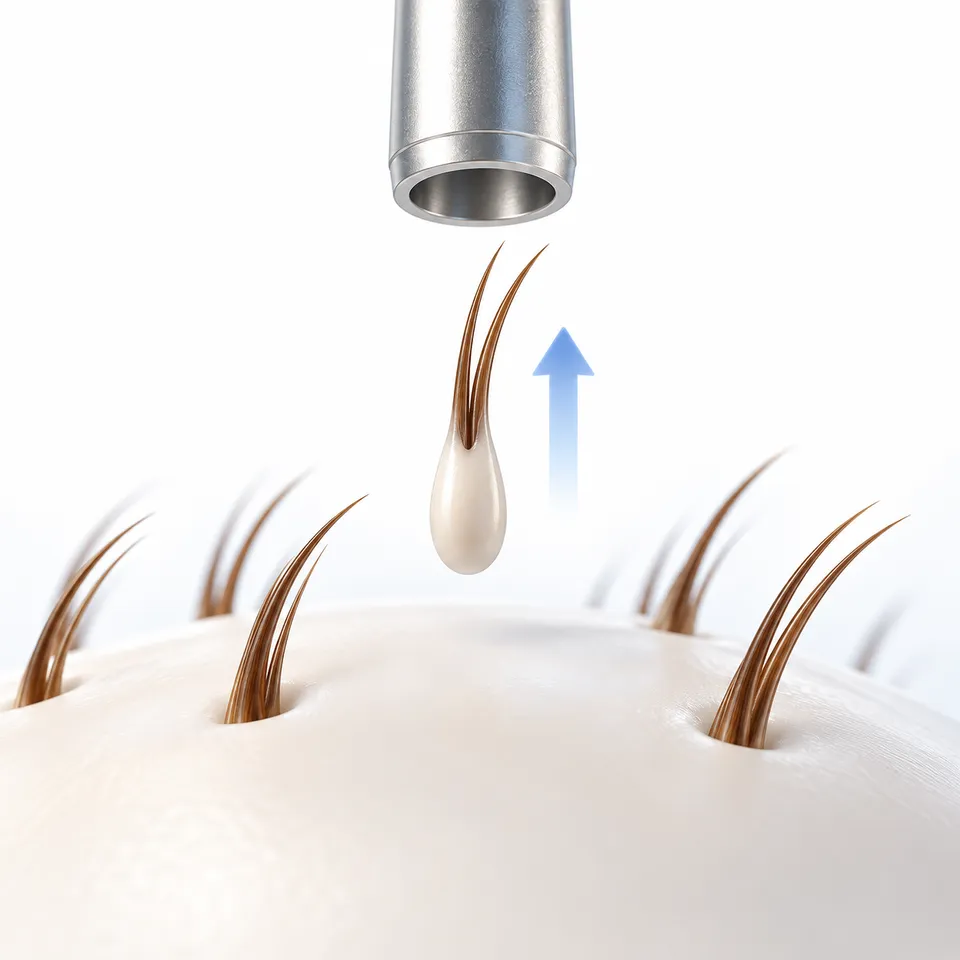
FUE describes the individual extraction of follicular units.
Hair transplantation is surgery. Possible risks include infection, scarring and a result that falls short of expectations. FUE is not scar-free either.
Personal informed consent must relate the risks to your situation. Neither a method name nor a graft count guarantees a result. Transplantation also does not automatically prevent other hair from continuing to thin.
The skin needs time to heal after surgery. Redness, swelling and crusts may occur. Hair growth develops over months, so the appearance immediately after treatment is not a finished result.
Care, rest and how to respond to unusual symptoms must be explained personally. Agree on follow-up appointments and contacts before planning treatment. General timeframes do not replace individual guidance on work, sport or hair care.
Agreed aftercare services and any separate charges should be included in the cost breakdown for your treatment.
Our guide to care and aftercare following a hair transplant explores washing, recovery and hair growth in more detail.
Note which area you would like to change and which questions matter to you. These include realistic options, responsible people, appointment locations, your quote and aftercare. You do not need to choose a method before your consultation.
Your medical contact is Melih Kandemir at Melimedicshair.
Find the address and visiting information on our page about the practice and directions.
To request an appointment, use the practice phone and email contacts.
Our Melimedicshair treatment overview helps you explore scalp hair, beard, eyebrows and hair medicine.
This information does not replace a personal examination. Discuss which treatment may be suitable with your doctor.
Information from Melimedicshair. Meet the doctor and practice.
Medical sourcesISHRS – FUE ↗NHS – Procedure and risks ↗These answers can help you prepare.
This can only be assessed after a medical examination. The cause of hair loss, donor hair and your health are taken into account.
No. Individual extraction also leaves small scars. This limitation should be explained clearly during informed consent.
No. You can bring your questions to the consultation and discuss the different steps together.
Not necessarily. FUE describes extraction and DHI an implantation technique. They can be combined. Selection is part of medical planning.
Recovery is individual. Skin healing and hair growth are different processes. General timeframes cannot replace personal instructions on care, rest and follow-up.
Scalp hair transplants at Melimedicshair start from €2,500. Your personal price depends on the planned extent and agreed services. You receive a binding quote after medical assessment.
What is possible for you, what does treatment involve and how are costs determined? You do not have to work through these questions alone.