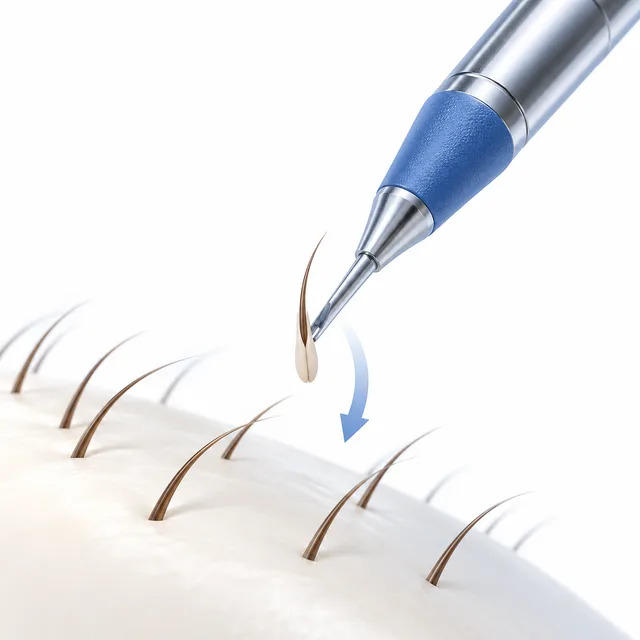
Donor area and reserve
Extraction must suit the available hair and longer-term plan. Maximising graft count is not a treatment goal in itself.

FUE describes how follicular units are extracted from the donor area. DHI describes a placement technique. Both can be part of the same hair transplant. It is therefore worth considering the steps separately before deciding.
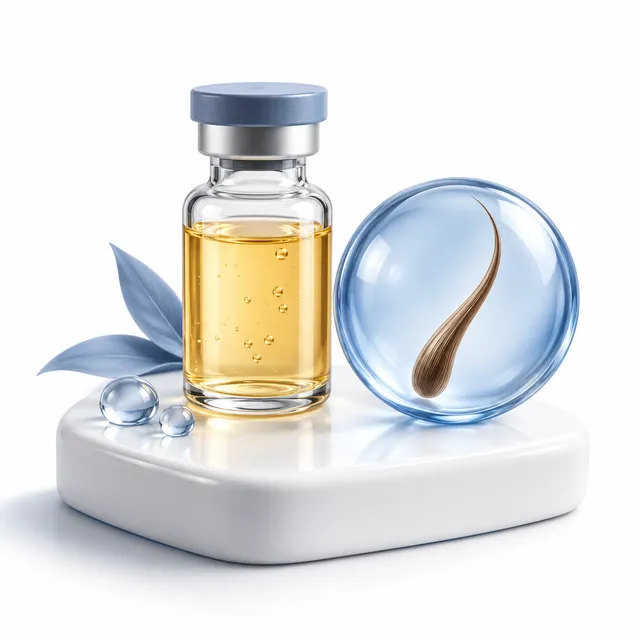
A transplant moves existing hair follicles. This requires extraction and implantation. FUE and DHI describe different functions within this process here, rather than two complete treatment alternatives.
The full decision process, including requirements and healing, is explained in our hair transplantation information. This page focuses on the technical terms.
In FUE, follicular units are freed and extracted from the donor area with a small round instrument. A unit may contain several hairs and is often called a graft.
FUE does not specify which instrument will be used to implant the grafts afterwards. FUE is also a surgical step and is not scar-free.
DHI is used here to mean placement with an implantation instrument. Previously obtained grafts are loaded into the instrument and placed in the recipient area. Extraction is a separate step.
The term is not used consistently everywhere. DHI alone therefore does not establish a standardised process. What matters is an explanation of how extraction and implantation will actually be performed.
Grafts extracted using FUE can subsequently be placed with an implantation instrument. DHI does not replace extraction in this combination. The word “direct” also does not mean the entire treatment involves no preparation or skin injury.
This explains the principle. Instruments, sequence and individual responsibilities for your procedure must be explained separately.
Not every form of hair loss is suitable for transplantation. Before choosing technical steps, the cause, health and available donor hair must be examined.
Extraction must suit the available hair and longer-term plan. Maximising graft count is not a treatment goal in itself.
Hairline, existing hair and desired distribution belong together. An instrument alone determines neither density nor a natural appearance.
Before deciding, it should be clear who performs treatment, where appointments take place and how aftercare is arranged.
Your medical contact at Melimedicshair is Melih Kandemir.
For thinning hair, see our guidance on PRP and hair medicine.
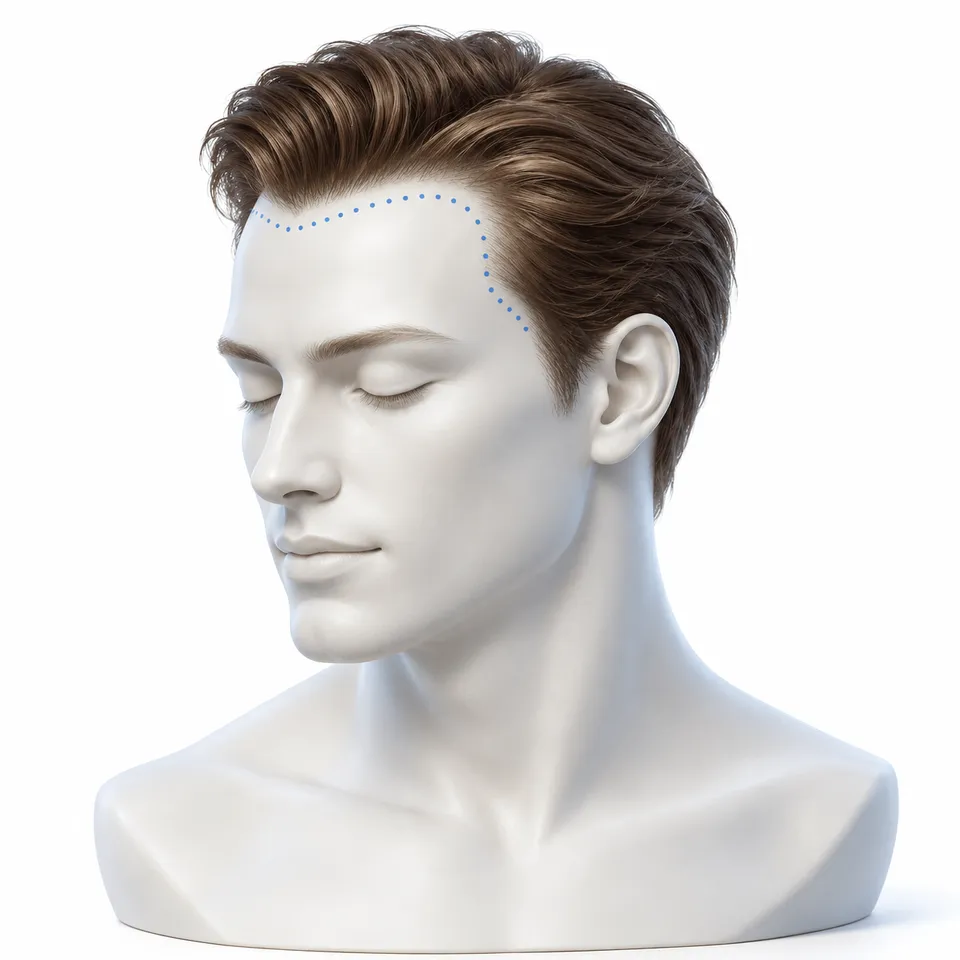
Personal planning comes before choosing technical steps.
Possible hair transplant risks include bleeding, infection, scarring and a result that falls short of expectations. Excessive extraction can thin the donor area.
Neither FUE nor DHI guarantees that every graft will grow or that a particular density will be achieved. The terms do not establish your personal healing time either. Your individual risks belong in medical informed consent.
The treatment page covers hair transplant risks and limitations.
A clear comparison distinguishes extraction, handling of grafts and implantation. It includes the planned extent, responsible people and care. An advertised technique name does not answer these questions.
This does not establish general superiority. The interactive comparison below illustrates the two functions; the FUE and DHI explanations are already fully readable above.
For questions about FUE costs or DHI costs, the hair transplantation cost overview is a useful addition.
For your personal question, reach us through contact and consultation.

A meaningful comparison explains extraction, implantation and agreed services.
This information does not replace a personal examination. Discuss which treatment may be suitable with your doctor.
Information from Melimedicshair. Meet the doctor and practice.
Medical sourcesISHRS – FUE: extraction, donor area and limitations ↗ISHRS – Hair transplantation ↗AAD – Requirements and personal treatment planning ↗NHS – Procedure and risks ↗The terms describe different steps: extracting and implanting hair follicles.
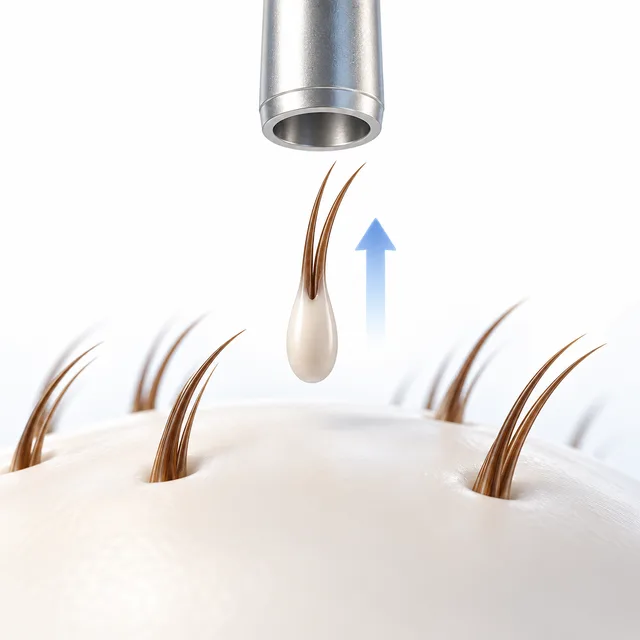
FUE uses a fine instrument to extract individual follicular units from a suitable donor area.
DHI is an implantation technique using a dedicated instrument to place hair follicles. Extraction may first be performed using FUE.
Medical planning determines the suitable approach. No technique is universally superior.
Medical sources: ISHRS – Hair Transplant Surgery ↗. Artificially generated illustrations, schematic and not to scale.
These answers can help you prepare.
No. FUE describes extraction; DHI here describes placement with an implantation instrument. Both steps can be combined in the same treatment.
This comparison concerns different functions. A method name alone does not demonstrate superiority, better density or a higher chance of success. Examination, planning and execution are decisive.
No. Individual extraction creates small wounds that can leave scars. Placement is also a surgical step.
No. A graft is a small tissue transplant; a follicular unit may contain several hairs. A graft count is therefore not simply a hair count.
These terms do not establish your personal healing time. They concern different steps that may even be combined. Care and rest depend on personal medical instructions.
No. Individual suitability is assessed only after examination. Bring your goals and questions; you do not need to decide on a technique beforehand.
What is possible for you, what does treatment involve and how are costs determined? You do not have to work through these questions alone.